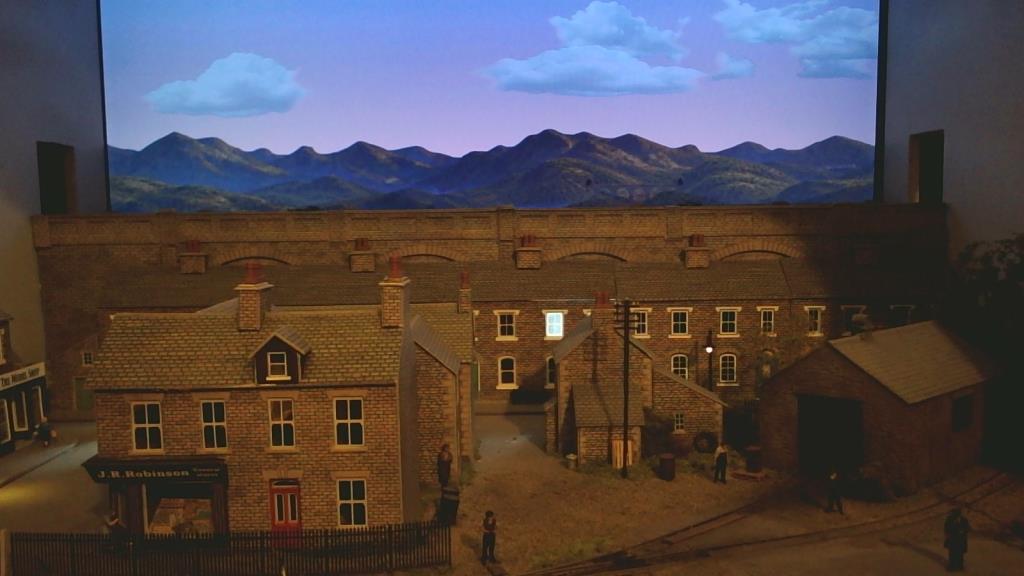
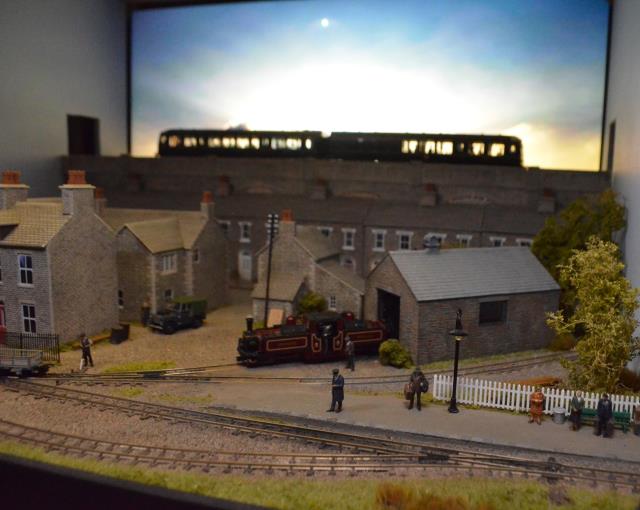
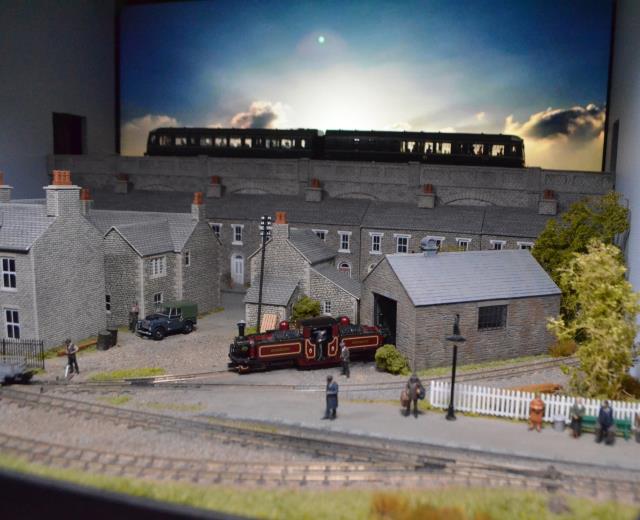
Anyone who has followed the story of Bond Lane may remember that we took a certain pride in saying there was no Raspberry Pi or Arduino controlling the layout. The changing light, the streetlights and the illuminated houses were all driven by a collection of light sensors, hidden patches on the backscene video and some fairly straightforward analogue electronics.
That was true when we wrote it. It isn’t any more.
The original system served us remarkably well. It was inexpensive, easy to understand and, most importantly, it worked reliably at exhibitions. It also helped give Bond Lane much of its character. When the sky darkened, the lighting followed; when lightning flashed on the screen, the layout responded. For a solution assembled from simple components, it could be surprisingly convincing.
However, the more we used it, the more we began to see its limits. The lights could react to what a sensor was seeing, but there was only so much control we could have over the result. We wanted daytime scenes to be brighter, night scenes to become properly dark, and the transitions between them to have more range. We also had ideas for effects that would have been awkward, or in some cases impossible, to achieve with the existing arrangement alone.
So, after several years of insisting that Bond Lane had no computer brain, we have introduced a Raspberry Pi.
The important thing is that the Pi is not there for technology’s sake. Visitors do not need to see it or know that it is running. Its job is simply to give us more precise control over the lighting and effects so that everything in the scene feels as though it belongs together. We can now tell the lighting much more deliberately what to do at each stage of the sequence, rather than relying entirely on a sensor to interpret what is happening on the screen.
The most obvious improvement is the greater range between light and dark. Daylight can have more punch, while night-time scenes can be much deeper and more atmospheric. The lighting can change more subtly when that is what the scene needs, or much more dramatically when the weather turns. It also gives us room to introduce additional effects without creating an ever-growing collection of separate circuits.
None of this diminishes what the original analogue system achieved. In fact, it gave us the confidence to take the next step. Those simple light sensors proved that synchronised lighting could transform a fairly conventional model railway scene. The Raspberry Pi lets us build on that idea with more control, more contrast and more possibilities.
There is a pleasing irony in all this. Bond Lane began with us saying that a Raspberry Pi would be unnecessary complexity. Several years later, the layout has developed to the point where it has become the simplest way to achieve what we now want. As with many of Bond Lane’s features, the solution was not part of a grand plan — it emerged because the layout presented us with a new problem to solve.
The change has arrived alongside another major development: a completely new, fully animated backscene created specifically for Bond Lane. We will look at that in the next article, and at how the new animation and the Raspberry Pi-controlled lighting work together to make the whole scene more convincing.
by Neil Limbrick
506 views
14 days ago
by Neil Limbrick
326 views
21 days ago
by Neil Limbrick
5934 views
328 days ago
by Neil Limbrick
5476 views
2 years ago
by Neil Limbrick
4369 views
2 years ago
by Neil Limbrick
4315 views
2 years ago
by Neil Limbrick
3958 views
2 years ago
by Neil Limbrick
3606 views
2 years ago